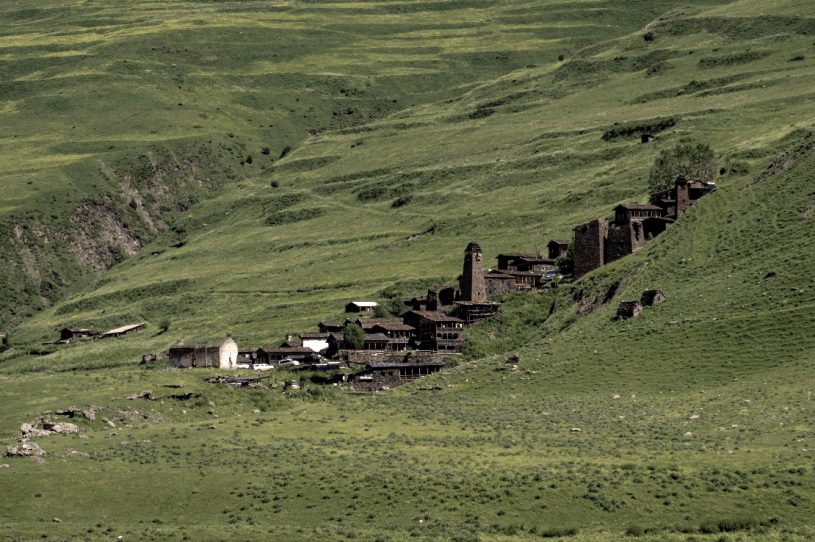
The following text is an edited excerpt from the illustrated volume by Applis, Stefan, Florian Mühlfried, and Gwendoline Lemaitre. Tuschetien. Natur- und Kulturraumwandel im Großen Kaukasus[Tusheti. Changes in the Natural and Cultural Landscape of the Caucasus]. Halle: Mitteldeutscher Verlag, 2025.
Tusheti is a historic region in the Caucasus. To the north, it is separated from the Republic of Chechnya within the Russian Federation by a mighty mountain range. To the west, another mountain range separates it from the neighbouring Georgian regions Pshavi and Khevsureti. Since the Tusheti region became a UNESCO biosphere reserve, tourism has been steadily increasing.
Due to its remote location, traditional architecture has been preserved there largely unchanged. This architecture reflects the changing regional security situation at the turn of the 19th and 20th centuries, brought about by the gradual incorporation of the North Caucasus into the Russian Empire. Using the example of the high-mountain architecture of the villages of Tusheti, the following article provides an explanation of the associated settlement structures and illustrates that one can clearly trace the evolution of regional security regimes through text, drawings and photographs.
Read the full article on Peripheral Histories ISSN 2755-368X
 Geographien | doing geography