
The following text is an excerpt from the travel guide "Discovering Tusheti", which will be published in 2024 by Mitteldeutscher Verlag Halle, and is co-authored by the ethnologist Florian Mühlfried and the geographer Stefan Applis.
The name of the biosphere reserve, „Three Alasani Rivers“, is taken from the water basin where the Alazani River and the rivers of the same name running north of the watershed, the Tushetis Alazani and the Pirikitis Alazani, have their origin. The Alazani itself rises from the main southern ridge of the Great Caucasus and flows southeast through the Alazani Valley of Kakheti. The biosphere reserve has an extension of 199,944 ha. It includes the region of Tusheti in its historical-geographical boundaries, the lowland area of Akhmeta municipality (excluding the town itself), Pankisi Gorge and the permanent residential areas of the Tusheti municipality, as well as part of the Alaverdi floodplain forests, the village of Alaverdi and part of Stori Gorge, which belongs to Telavi municipality.
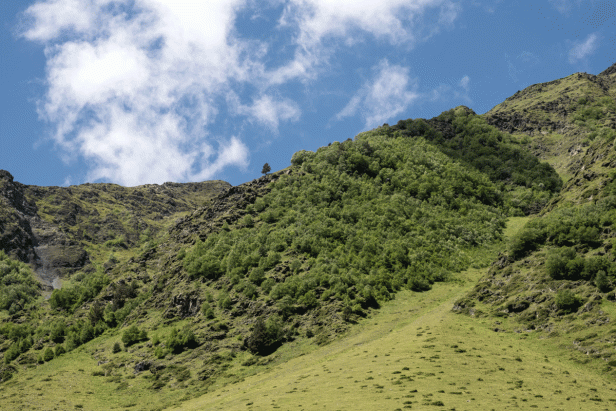
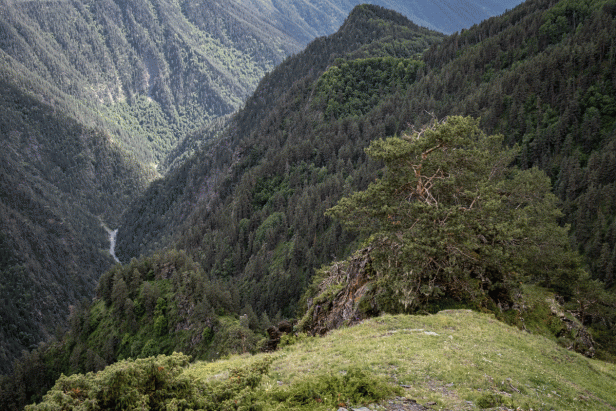
The Caucasus Biodiversity Hotspot is one of 34 biodiversity hotspots worldwide – the „Three Alasani Rivers Biosphere Reserve region“ is particularly important regarding its ecological heritage. The Caucasus hotspot has the most extraordinary biodiversity of any temperate forest region in the world, including more than 6,500 species of vascular plants, of which at least 1,600 (25 %) are endemic. Its forests, high mountains, wetlands, steppes and semi-deserts contain more than twice the plant and animal diversity found in neighbouring regions of Europe and Asia. The Three-Alasani Rivers Biosphere Reserve is one of the most biodiverse regions of Georgia in terms of plant and animal diversity, especially in the northern part of Tusheti. The vegetation includes floodplain forests, mountain and subalpine forests, subalpine shrubs, mountain meadows, subalpine and alpine grasslands, subnival vegetation and boulder vegetation.


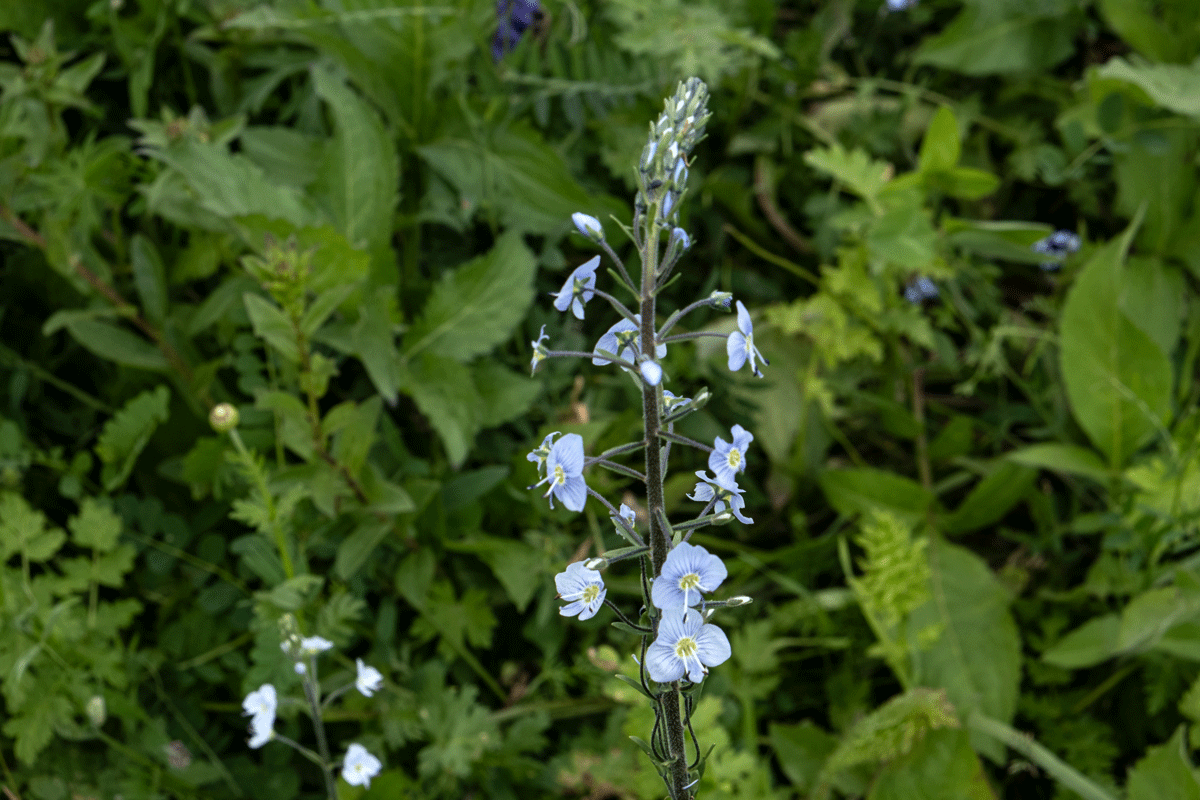
More than 1,000 vascular plants from 92 families have been recorded in Tusheti; this is a quarter of all species in Georgia and a sixth of all Caucasian plants, including many endemic and rare species, e.g. Tushetian monkshood (Aconitum tusheticum), Caucasian cowslip (Primula luteola) or Tushetian rose (Rosa tushetica). In Tusheti, there are many endemic species, i.e., plants that only occur in Tusheti – about 22.5 % of all plant species are endemic (11 Georgian and 230 Caucasian). Eleven plant species are on the Georgian Red List: Caucasian shrub birch (Betula raddeana), mountain elm (Ulmus glabra), field elm (Ulmus minor), juniper (Juniperus foetidissima), Colchian box (Buxus colchica), wingnut (Pterocaria pterocarpa), Caucasian zelkove (Zelkova carpinifolia), European yew (Taxus baccata), sweet chestnut (Castanea sativa), English oak (Quercus pedunculiflora), walnut (Juglans regia). Around 300 plant species still in Tusheti are on the International Red List of Threatened Plants.
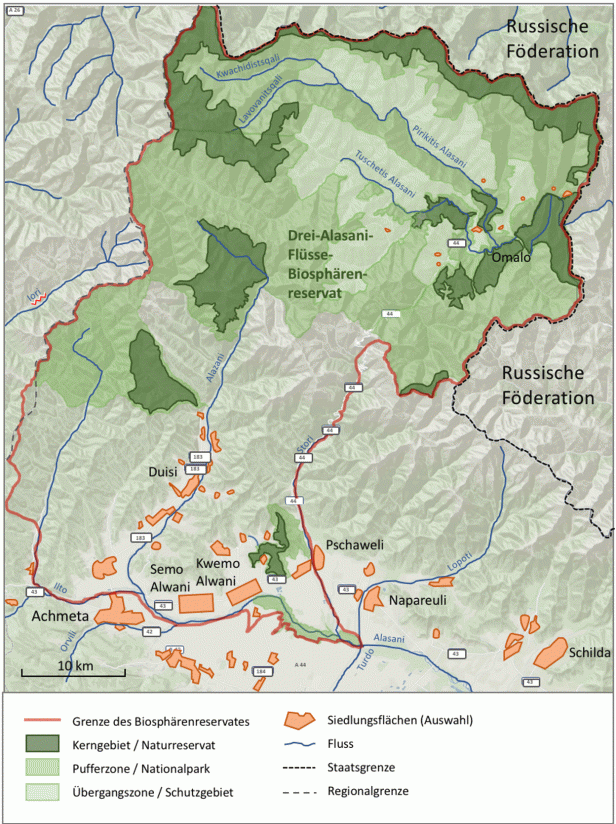
Map: Biosphere Reserve „Three Alazani Rivers“ (Map: Stefan Applis 2022, map basis mapcarta)
The fauna of the area is also diverse. On the territory of the Three Alasani Rivers Biosphere Reserve, 71 species of mammals, 182 species of birds, 17 reptiles, seven amphibians and 26 species of fish can be observed. The most important mammal species include the East Caucasian turk (Capra cylindricornis), the Caucasian population of the wild goat (Capra aegagrus), the chamois (Rupicapra caucasica) and the red deer (Cervus elaphus), as well as several endemic species of other small mammals. Large predators include the brown bear (Ursus arctos), the grey wolf (Canis lupus) and the lynx (Lynx lynx).


Two endemic species represent birds – the Caucasian black grouse (Tetrao mlokosiewiczi) and the Caucasian snowcock (Tetraogallus caucasicus). Among the large birds of prey are the griffon vulture (Gyps fulvus), the black vulture (Aegypius monachus), the bearded vulture (Gypaetus barbatus) and the golden eagle (Aquila chrysaetos), all of which are on the Red List of Endangered Animals in Georgia. The region of Tusheti is recognised as one of Georgia’s Important Bird Areas by BirdLife International, one of the most important international bird conservation organisations.
In the lowlands, agriculture is practised, i.e. viticulture, arable farming, livestock and sheep breeding, and fruit and vegetable growing. In the mountain regions, forestry and tourism are added as further economic sectors; sheep and cattle breeding are particularly important here.
Support to improve the livelihood of local communities is as important as the economic development of the whole region. By promoting traditional work activities and introducing modern and sustainable technologies, the biosphere reserve aims to support the economic development of local communities, enterprises and businesses in production and service-oriented sectors (agriculture, forestry, tourism, etc.). Within the biosphere reserve approach, the main aim is to certify sustainable economic activities; extensive educational measures are also considered necessary for this purpose. Nomadic sheep farming is the most important agricultural activity in Tusheti. It is based on the system of alternating summer and winter pastures, known as transhumance. The winter pastures in the Shiraki Valley of Dedoplistszqaro municipality cover 18,722 ha. The Tushetian mountain pastures are visited in summer. In this way, the shepherds use seasonal natural pastures for their sheep – alpine and sub-alpine pastures in summer (April to September) and steppe-climate pastures in winter (November to March). For this purpose, the sheep are led in autumn on particular, state-determined paths to the Shiraki region in the Dedoplistszqaro biosphere reserve, which is about 200 – 300 km away from Tusheti; in spring, the cattle are driven in the opposite direction. The flocks of sheep are led by a few goats and are often accompanied by horses and cattle, which are also kept in the summer and winter pastures. The horses are mainly used for transport, the cattle for milk and meat production.
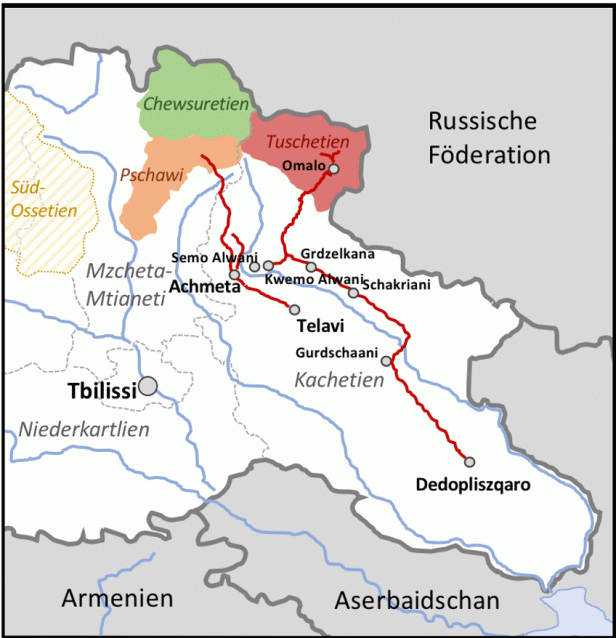
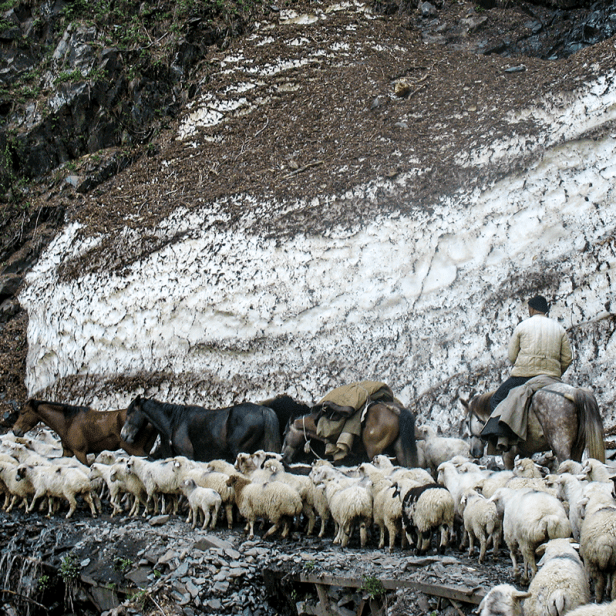
Map: Transhumance migration routes (Stefan Applis 2023)
Accordingly, transhumance as a traditional land use connects and shapes both areas. Therefore, sustainable projects for preserving the transhumance routes as a connecting corridor between both biosphere reserves are significant in conserving and developing the Tusheti cultural and natural area.
Text: Stefan Applis (2023)
Photography: Florian Mühlfried (2007) & Stefan Applis (2023)
 Geographien | doing geography
With all due respect, I’d suggest several corrections:
1. It’s Three Alasani not „Three Alaskan“
2. Capra is „tur“, not turkey
3. Tetraogallus caucasicus is a snowcock, not a snipe.
Best,
N
LikeLike
Thank you very much, I made the corrections. I translated the text too quickly without taking time enough to sorrowfully read it several times! Best, Stefan
LikeLike
Hello! Is the Book about Tusheti published yet, and can you find it english? Best Regards Lena Haglund from Sweden who visited Tusheti five Times and loves it!!
LikeLike