
The following Text is taken from a journal article published by Nino Tserediani, Kevin Tuite & Paata Bukhrashvili: Women as Bread-Bakers and Ritual Makers. In Tsypylma Darieva, Florian Mühlried & KevinTuite (2018). Sacred Places, Emerging Spaces. Religious Pluralism in the Post-Soviet Caucasus. Berghahn: New York, Oxford. Below, in a video produced for the Latali Records project in 2023, Dr. Nino Tserdiani explains the key aspects of the importance of ornaments in Svan culture. In the film clip, in addition to the patterns created by stamps or shapes during the baking of ritual bread, she explains patterns found on wooden elements of the interior decoration of traditional residential buildings. The following text excerpt focuses on background knowledge about ritual bread baking.
Women in the ‘Kitchen’ as Bread-Bakers and Ritual Celebrants: The Lidbäš Rituals
Within the Svan home, the space traditionally reserved for women was centred at the hearth, where cooking and baking take place, and included the food-storage areas. Among the tasks relegated to women in Svaneti, as elsewhere in the Caucasus, is the making of bread. The role of chief bread-baker (merbiēl) is held by the senior woman of the household. In addition to making bread for family meals, she prepares special types of bread called lemzir, to be offered in churches and other sacred sites (Tserediani 2005). Bread as an offering to supernatural beings echoes the Orthodox Eucharist, but in all likelihood continues a practice that predates Christianity. Throughout Georgia, bread is a canonical offering at folk-religious ceremonies, along with sacrificed animals, alcoholic beverages and beeswax candles. Svaneti, however, stands out from the rest of Georgia both with respect to the elaborate variety of lemzir breads, and the ritual functions assumed by the merbiēl. She is in many respects the female counterpart of the maxwši, as the senior member of her gender within the household, and as ritual specialist.
Based on our fieldwork of the past three years, and earlier investiga-tions carried out by Tserediani and Bardavelidze, the sites where women preside at rituals, usually to the exclusion of men, are of three kinds. collective term sometimes used for these rituals is lidbäš, a participle formed from the same root as ladbäš, mentioned previously as one of the names of the food-preparation wing of a Svan church. The Svan language even has a special verb idbäši, based on the same root as ladbäš, which denotes the baking and offering of bread by women […]. Women might also offer vodka and candles, but do not sacrifice animals (that being an exclusively male prerogative).
The woman-led ceremonies that have drawn the most attention from ethnographers take place at the hearth, or sometimes at other places inside the house (Chartolani 1977). These are directed at female-gen-dered divinities, such as Barbal (St Barbara) or Lamǟria (Mary), or a domestic spirit known in some localities as mezir. These rituals, especially those invoking the mezir, are strictly off-limits to men. A text recorded in Lenǰeri describes a ritual performed at the laying of the foundation for a new house, at which women bake bread offerings for ‘the God of the Underworld’ (čube buāsdä ɣērbat), who is asked to assure the good fortune of the household (Shanidze, Kaldani and Ch’umburidze 1978: 108–13).
Nino Tserdiani on the Svan house and traditional gender roles
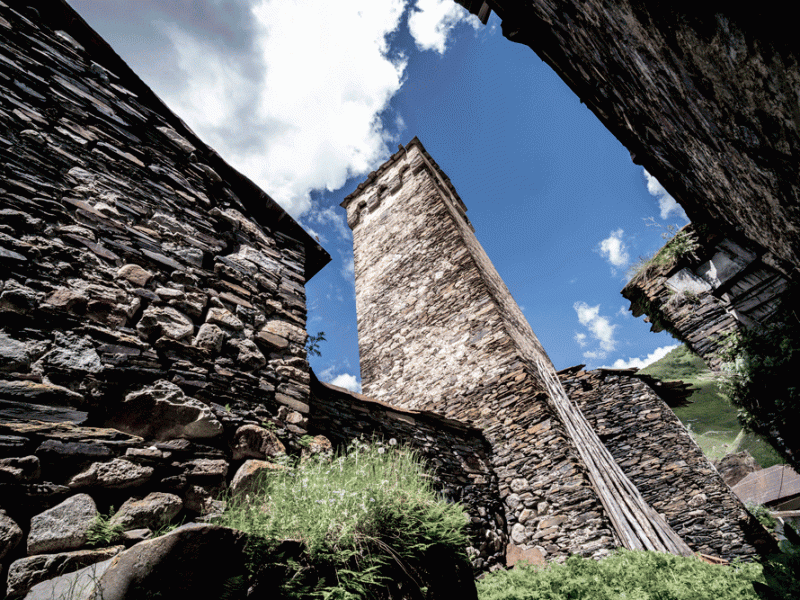
Svaneti Series | Traditional customs & habits – The Svan house and the role of the man
The article series „Svaneti Series“ (distributed via Twitter @doinggeography) provides insights and analyses of the histoircal region of Svaneti in Georgia social life from a geographical viewpoint. This means that…
Text: Nino Tserediani, Kevin Tuite & Paata Bukhrashvili: Women as Bread-Bakers and Ritual Makers. In Tsypylma Darieva, Florian Mühlried & KevinTuite (2018). Sacred Places, Emerging Spaces. Religious Pluralism in the Post-Soviet Caucasus. Berghahn: New York, Oxford.
Video: https://latalirecords.com/ (2023)
 Geographien | doing geography